An heraldic primer - part 1
This is the first of a series about basic heraldry and
the principles involved. It is written in a way to assist
the reader gain a basic understanding of heraldry. Hopefully
this simplification of the process with not offend the scholarly
heraldists amongst us!
Many family historians conduct all their ancestral researches
without taking even taking a passing interest in heraldry.
To the uninitiated, heraldry can be a complicated and bewildering
subject. However, we see evidence of it practically every
day of our lives in the form of company arms or badges.
Often we come across personal coats of arms in parish churches
whilst on our own private ancestral trails and, unless we
know the names of those who bore these arms, they make very
little impact on most of us. Usually, of course, they belong
to a prominent local individual, possibly the lord of the
manor or perhaps a landowner for whom our ancestors once
worked.
 Occasionally
some of us will be made aware of a family heirloom or seal,
which is supposed to have carried the arms of an ancestor,
which may excite our curiosity. We wonder if we can find
out more about it, or whether it was possibly the arms of
a family for whom an ancestor may have worked. All too often,
however, we discard the prospect of finding any armigerous
ancestors, on the grounds that our ancestors’ families
were too poor for anyone ever to have had any arms. This
may well be the case, but it has also always been much easier
to slide down the social scale than to climb up it, so families
with working class backgrounds in the 19th century may well
descend from more prosperous ancestors in previous centuries.
If you are lucky enough to discover a coat of arms granted
to one of your ancestors, then the bonus is that there is
certain to be an associated family pedigree available which
will tell you even more about that person and their ancestry. Occasionally
some of us will be made aware of a family heirloom or seal,
which is supposed to have carried the arms of an ancestor,
which may excite our curiosity. We wonder if we can find
out more about it, or whether it was possibly the arms of
a family for whom an ancestor may have worked. All too often,
however, we discard the prospect of finding any armigerous
ancestors, on the grounds that our ancestors’ families
were too poor for anyone ever to have had any arms. This
may well be the case, but it has also always been much easier
to slide down the social scale than to climb up it, so families
with working class backgrounds in the 19th century may well
descend from more prosperous ancestors in previous centuries.
If you are lucky enough to discover a coat of arms granted
to one of your ancestors, then the bonus is that there is
certain to be an associated family pedigree available which
will tell you even more about that person and their ancestry.
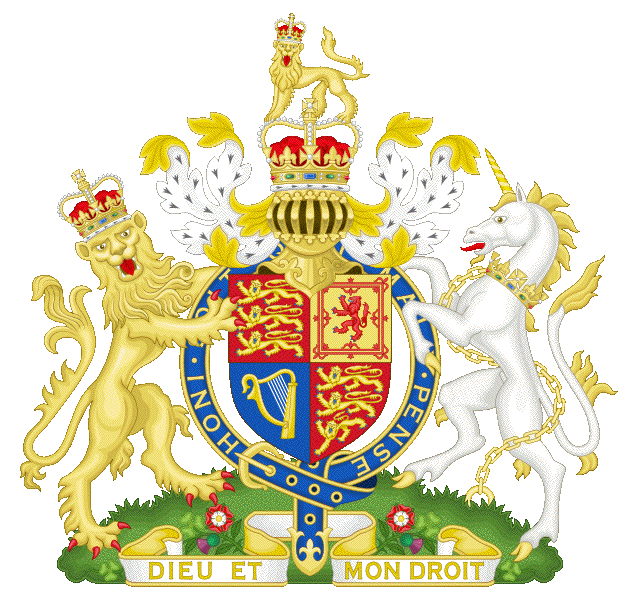
Pictured: The Royal Arms of the United Kingdom.
While genealogists need not concern themselves with heraldry,
a herald relies on genealogy to determine the ownership
and succession rights to heraldic devices.
On the other side of the coin many are caught up in the
yearning for notoriety and seek out a so-called family
crest. This is partly because many of us assume a family
crest is a coat of arms and is to be associated only
with the upper classes and the peerage. Unfortunately a
family crest is something rather different as this
series will explain in later columns. Such vulnerable people
are often easily parted with their money by the unscrupulous.
Indeed if this series of articles does no more than prevent
some readers from succumbing to the coats of arms craze,
it will have been successful.
In the next
issue we will cover the origins of heraldry.
Graham Jaunay BA DipT MACE AAGRA
Originally published as a series in, Relative Thoughts,
Fleurieu Peninsula Family History Group
|