An heraldic primer - part 5
Blazon—the language of heraldry
From the very earliest times heralds have employed old
French as the language to describe arms. Of course this
was the every day language of the upper classes of the time.
Today this language, called blazon still contains old French,
but many terms have been anglicised and new ones added.
If one addresses the description in the same systematic
way used by modern heralds, together with a knowledge of
the language used, it is relatively easy to crack the code
after a little practice.
The first step in blazoning is to describe the background
colour or field. (see the last instalment) The background
may be divided or parted—thus party per pale
(usually shortened to per pale) signifies the background
is divided vertically. (black is a shading for sable)

Common Partitions L-R: fess; pale; bend; bend sinister;
quarterly (or cross); saltire; chevron.
 These
are just the basic partitions. They can be multiplied and
thus many per chevrons becomes chevrony,
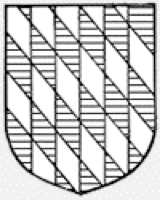
many per pales become paly. They can also
be combined so that paly combined with bendy
becomes paly bendy. (pictured adjacent) These
are just the basic partitions. They can be multiplied and
thus many per chevrons becomes chevrony,
many per pales become paly. They can also
be combined so that paly combined with bendy
becomes paly bendy. (pictured adjacent)
The second step is to describe the principal shape or charge
on the shield or escutcheon. If they are geometrical
shapes they are known as Ordinaries. Their width
is determined largely by what device if any they have on
them. The simplest are pictured, but they need not have
straight edges. Each form can also have a diminutive version
and thus a bend becomes a bendlet, pale
becomes pallet, etc. Some forms do not have a diminutive
but in the case of crosses there are twenty common variations.
If they are combinations of creatures or inanimate shapes
they are known as charges.

Some Ordinaries L-R: ; bend; bend sinister; chief; fess;
pale; cross; saltire; pall; chevron; pile.
In the third stage other charges on the field are
described next, followed by any charges upon the
main charge.
Finally any charges on the Ordinaries
are described.

Examples of Charges: L-R: eagle displayed; lion rampant;
unicorn passant; enfield; gryphons-segreant; mermaid; opinicus;
wyvern.

Inanimate charges to left: mullet pieced; castle; harp,
spur; sun
Partitioning can accommodate the following formats.

Examples of partitioning: L-R: dancetty, dovetailed,
embattled, engrailed, fleury, nebuly, potented, indented,
invecked, raguly, rayonny.
In the
next issue we will see how this is all put together.
Graham Jaunay BA DipT MACE AAGRA
Originally published as a series in, Relative Thoughts,
Fleurieu Peninsula Family History Group
|