An heraldic primer - part 4
How to read the Shield on a Coat of Arms
Having determined the origins of heraldry in the previous
series of articles and how the scheme is administered, we
now turn our attention to the task of interpreting shields
that we come across in our research. The shield on a Coat
of Arms is the only unique feature of a Coat of
Arms and then it need only be unique for the country
in which the owner resides. Shields come in all sorts of
shapes and sometimes the shape can be a pointer to the country
of origin. In England the lozenge (diamond) shape
is reserved for women who may bear the arms of their father
or husband or if they are the heraldic heiress
and unmarried, they may bear their own arms. There are a
few exceptions to this rule, the current Queen being one
of them, who although married, is deemed more important
than her husband and thus entitled to her own arms and not
portrayed in a lozenge!
Shields are described from the perspective of the wearer
and not the viewer and thus the right (dexter)
side is on the left (sinister) in diagrams. The
language used in blazoning (description) of a shield
is intentionally precise and quite difficult to follow in
the special language of heralds.
The shield is coloured using the metals, or (gold) and argent
(silver), the tinctures (colours): gules (red), azure (blue),
sable (black) and vert (green), the less common stains:
purpure (purple), tenné (brown), murrey (mulberry)
and sanguine (blood red) with furs including ermine, vair
and potent. Sometimes other colours have been used but this
is considered irregular! A colour is never placed adjacent
to a colour or a metal to a metal. Because, like this journal,
the heraldic artist cannot always portray the shield in
colour, shadings were devised to denote these colours.

Left to right: The shading for some metals/colours/tinctures:
Or (gold), Argent, Gules, Azure, Vert (green), Murrey, Sable
The full range of 'colours' depicted on a British coat of
arms are:
Metals: Argent – Or
Colours (tinctures): Azure – Gules
– Purpure – Sable – Vert
Furs: Ermine (stoat winter fur) –
Vair (red squirel fur) ...furs come in a range of variations
often with their own names
Stains (staynard colours): Murrey (mulberry)
– Sanguine (blood red)– Tenné (brown)
Rare modern Stain: Bleu Celeste (sky blue)
Additonal colours:
European colours: Carnation (pale pink) – Cendrée
(ash grey)
South Afican colour: Orange
The unique design on a shield can be quite complex as they
are used to reflect the inheritance of arms down though
the ages. The earliest Grants of Arms can be quickly
identified because they have the very simplest of patterns.
However, if the current owner 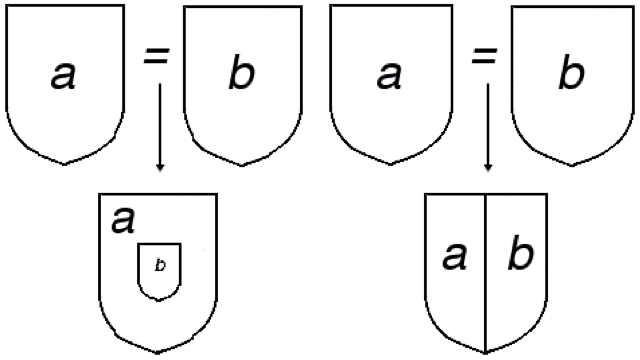 of
a Coat of Arms known as an Armiger descends
from a multitude of past owners of arms, then his shield
can be quite a mixture of many shields through a process
known as quartering. Just how this works is quite simple.
If a man marries an heraldic heiress (ie a woman
with no brothers whose father bears arms) then he will add
his wife’s shield to the centre of his own—an
escutcheon of pretence. If he marries a woman with
brothers bearing her father’s arms his shield is divided
vertically (impaled) to indicate a marriage with
the dexter half bearing the husband’s (baron)
and the sinister the wife’s (femme) design.
Holders of official positions are deemed married to their
position and personal arms may be impaled with
the arms of office. The impalement ends when the union ends. of
a Coat of Arms known as an Armiger descends
from a multitude of past owners of arms, then his shield
can be quite a mixture of many shields through a process
known as quartering. Just how this works is quite simple.
If a man marries an heraldic heiress (ie a woman
with no brothers whose father bears arms) then he will add
his wife’s shield to the centre of his own—an
escutcheon of pretence. If he marries a woman with
brothers bearing her father’s arms his shield is divided
vertically (impaled) to indicate a marriage with
the dexter half bearing the husband’s (baron)
and the sinister the wife’s (femme) design.
Holders of official positions are deemed married to their
position and personal arms may be impaled with
the arms of office. The impalement ends when the union ends.
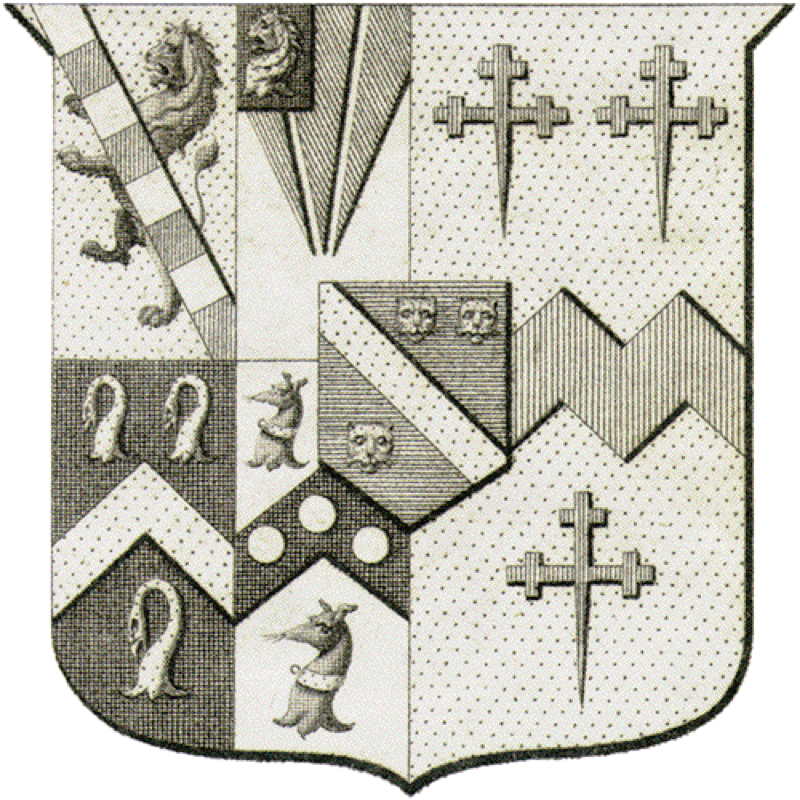
 Eventually a shield may be divided into four or more divisions
(quartering) each with a coat of arms inherited
by marriages to heraldic heiresses. This can become
quite complex and many armigers faced with this
problem at some stage arrange a simplification of their
shield to show just the main ancestral families.
Eventually a shield may be divided into four or more divisions
(quartering) each with a coat of arms inherited
by marriages to heraldic heiresses. This can become
quite complex and many armigers faced with this
problem at some stage arrange a simplification of their
shield to show just the main ancestral families.
Other features appear on the shield and these mainly fall
into one of the following categories. An augmentation
is an addition to the shield granted in recognition of a
deed or service. Thus when the Duke of Norfolk helped the
king to defeat the Scots, he was granted an augmentation
in the form of the Scottish arms with the lion toppled!
A diagonal bar denotes the illegitimacy of an ancestor.
Pictured: Henry Godfrey Fausett (1749–1825) showing
Godfrey's arms using shadings on the left, the arms of his
first wife, Susan Sandys, on the right, and the arms of
his second wife, Sarah Nott, in pretence at the
centre. The Godfrey's arms being quartered themselves with
the arms of the families of Fausett, Bryan, Godfrey and
Toke
Cadency marks are small symbols in the centre of
the upper part of the shield that are applied to denote
seniority within the family or [less often] to distinguish
branches of a family. In Scotland borders are used to denote
the positions in a family. A label is attributed
to the eldest son during his father's lifetime, a crescent
to the second son, a molet for the third, a martlet
for the fourth son, an annulet for the fifth, a
fleur-de-lis for the sixth, a rose the seventh,
a cross moline the eighth, an octofoil
or double-quatrefoil for the ninth son. When the father
dies, the eldest son discards the label and his brothers
are no longer entitled to display their father’s arms.
They may adopt a new version of their own, that is they
difference the arms.
In the
next issue we will cover Blazon—the language of heraldry.
Graham Jaunay BA DipT MACE AAGRA
Originally published as a series in, Relative Thoughts,
Fleurieu Peninsula Family History Group
|