An heraldic primer - part 3
In England the task of managing heraldic issues rests with
the Earl Marshal. The methodology of determining the right
to a specific coat of arms means that the Earl Marshal and
his counterparts in other countries undertake the study
of genealogy and the recording of family trees.
To do this exercise satisfactorily requires the appointment
of subordinates who are known as heralds. In England the
head of this bureaucracy is the Principal King of Arms known
as Garter. His [it has always been a male] current
annual salary is £49.07 which was fixed in the 1830s
and like his colleagues he supplements it with the private
work pertaining to individuals seeking the granting or recognition
of armorial bearings. Two other Kings of Arms; Clarenceux
and Norry and Ulster support him. These along with
six Heralds (Richmond, York, Chester, Lancaster, Windsor,
Somerset) and four Pursuivants (Rouge Croix, Rouge
Dragon, Bluemantle, Portcullis) form the College of
Arms under the Earl Marshal.
In Scotland the Court of the Lord Lyon consists
of three Heralds (Albany: Rothesay; Ross) and three
Pursuivants (Kintyre; Unicorn; Carrick) located
at New Register House Edinburgh.
The Republic of Ireland has a modern appointment in the
form of a Principal Herald now based in the PRO Dublin while
the matters for Northern Ireland are managed by Norry
functioning as Ulster King of Arms.
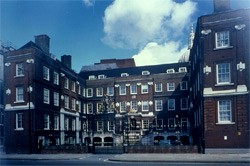
Pictured: College of Arms, London Headquarters
Originally all great nobles as well as the monarch had their
own heralds and some still maintain this right. Thus the
Earl of Derby has his Eagle Pursuivant and the
Earl of Erroll has his Slains Pursuivant, the Earl
of Crawford & Balcarres has Endure Pursuivant
and the Countess of Mar has her Garioch Pursuivant.
The current six heralds descend from officers for the peers
of the same name. Thus Richmond was the herald of the Earl
of Richmond.
The College of Arms is the official repository
for the coats of arms and pedigrees of English, Welsh, Northern
Irish and Commonwealth families. Its records include official
copies of the records of Ulster King of Arms the originals
of which remain in Dublin. Coats of arms are granted by
Letters Patent from the Kings of Arms. A right to arms can
only be established by the registration at the College
of Arms of a pedigree showing direct male line descent
from an ancestor already listed as entitled to arms, or
by making application through the College of Arms
for a grant of arms. Grants are made to corporations as
well as to individuals.
As the use of coats of arms progressed, the heralds evolved
a range of seemingly complex conventions to govern the designs.
In the
next issue we will learrn how to read the shield on a Coat
of Arms.
Graham Jaunay BA DipT MACE AAGRA
Originally published as a series in, Relative Thoughts,
Fleurieu Peninsula Family History Group
|